Estonia and Germany just upgraded their maritime relations in the Baltic Sea — Port of Tallinn has signed cooperation agreements with the ports of Hamburg and Lübeck, targeting new freight corridors, digitalisation, and a stronger supply chain.
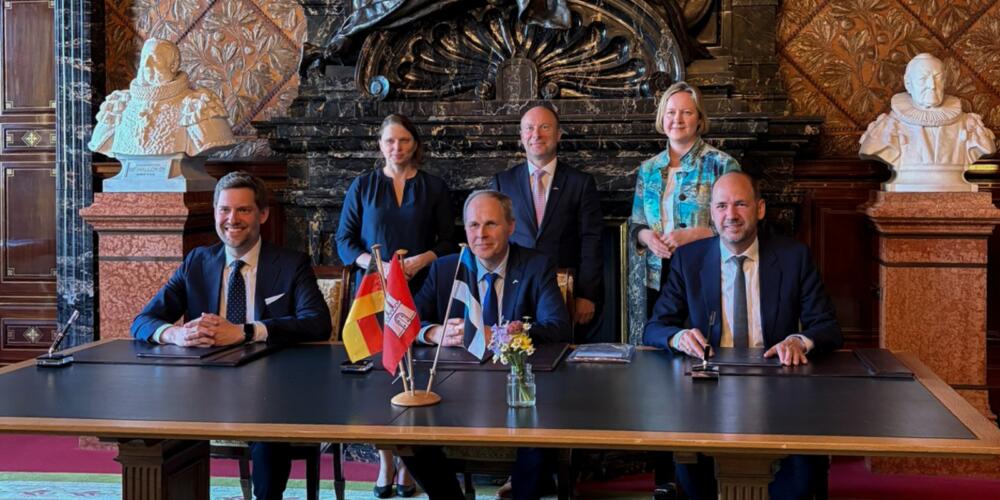
Kuldar Leis, Estonia’s Minister of Infrastructure, led a business delegation to Germany on 26 May, where Tallinn’s port authority signed cooperation agreements with the ports of Lübeck and Hamburg – two of the most strategically significant gateways in northern Europe, according to the Estonian Ministry of Climate.
The agreements should open a new chapter in a relationship that has been quietly deepening. Both Hamburg and Lübeck regard the Baltic states as holding significant economic importance, and Estonia in particular has been viewed as a benchmark for digital innovation in the maritime sector.
The agreement with Lübeck focuses on developing a dedicated sea transport corridor between Paldiski South Harbour and the German port, including the possibility of additional sailings or a new line operator. Lübeck is one of Germany’s leading Ro-Ro hubs on the Baltic coast – a port specialising in the transport of trucks, trailers, and wheeled cargo. The Hamburg agreement, meanwhile, targets cargo flow growth and knowledge-sharing on port digitalisation and cybersecurity. Hamburg is Europe’s largest rail port and Germany’s most important gateway for foreign trade.
An ever stronger Baltic connection
“Through the ports of Hamburg and Lübeck, we are better connected to Germany as Europe’s largest economy, and from there to other European markets,” said Minister Leis. “Estonia’s maritime sector has digital solutions to offer that help make cargo movement faster, cleaner, and more efficient. Today’s agreements grow business opportunities for Estonian companies, increase cargo traffic, strengthen our economy, and connect Estonia more firmly to Europe.”
Valdo Kalm, Chairman of the Board at Tallinn Sadam (Port of Tallinn), framed the deals as an elevation of an already active partnership. “For Tallinn Sadam, the ports of Lübeck and Hamburg are important strategic partners, and we see great potential to take our existing cooperation to a new level,” he said. Cargo between the two countries currently moves through Muuga Harbour and Paldiski South Harbour via regular Ro-Ro and container lines.
“Closer cooperation with German ports will help open new business opportunities in trade, cruise tourism, and real estate development,” Kalm added. “We also place great importance on sharing experience in digitalisation and cybersecurity, where the role of ports in ensuring the reliability and security of supply chains is growing.”
There is also a structural opportunity at play. Research on the Germany–Lithuania corridor has shown that shifting road freight to ferry and rail could reduce CO₂ emissions by approximately 70 per cent while strengthening supply chain resilience – an argument that applies equally to the Estonian corridor. Sea and inland waterways already account for over 72% of Estonia’s freight forwarding by mode, and with Rail Baltica continuing to take shape, multimodal connections to Germany are set to become more competitive.
The delegation also visited the LHG Skandinavienkai terminal in Lübeck and the headquarters of HHLA – one of Europe’s leading port and transport logistics companies – in Hamburg. It included representatives from Tallinn Sadam, HHLA TK Estonia, CF&S, Esteve, Via 3L, Transfennica, DFDS, Bruhn Speditioni, and Enterprise Estonia.
The Port of Tallinn handled close to 14 million tonnes of cargo in 2025, a further 5.1% increase on the previous year, with passenger numbers also up 1% to over 8 million. That continues a clear upward trend: cargo throughput had already risen 4.9% to 10.2 million tonnes in the first nine months of the year alone.
Are you interested in trading with Estonia? Enterprise Estonia is providing sourcing services for foreign enterprises. Contact Estonian export advisors or use our free e-consulting service to start trade with Estonia.