The vigorous growth of Estonian defence industry companies has proven that little Estonia can punch above its weight in the field of high-tech defence systems. According to Taavi Veskimägi, chairma of the Council of the Estonian Defence and Aerospace Association (EDIA), Estonia has set the goal of becoming a global innovation hub for the defence industry, where high-tech smart solutions are created at reasonable prices.
Taavi Veskimägi answers the questions.
The vision of the Estonian defence industry is nothing less than to shape Estonia into a hub for the smart defence industry. What does this mean? Where did this ambition come from?
Our goal is to fully integrate the Estonian defence industry into the broader European defence ecosystem, embedding Estonian companies into international defence industry value chains. By doing so, we aim to position Estonia as the most attractive jurisdiction for defence industry headquarters, particularly for companies developing disruptive technologies.
Estonia as a smart defence industry hub means that we have set the goal of becoming a global innovation centre for the defence industry, where high-tech smart solutions are created at reasonable prices, and which have an impact on the battlefield and create jobs for the people of Estonia. We are unlikely to ever produce tanks, but we can make them smart. If someone else provides the hardware, we know how to add the intelligence to it.
“We are unlikely to ever produce tanks, but we can make them smart. If someone else provides the hardware, we know how to add the intelligence to it.”
Taavi Veskimägi, chairma of the Council of the Estonian Defence and Aerospace Association
Our ambitions came about through more than 15 years of systematic development activity. We see that the strength of a small country can only be in innovation and the ability to provide solutions that best meet customer needs. The competitive advantage of our defence industry companies lies in close cooperation with the end customer, understanding the needs of the end customer, and what the product needs to accomplish on the battlefield and how. We must be quick not only in developing new solutions but also in their industrial offering so that customers around the world can trust our companies.
The vigorous growth of Estonian defence industry companies confirms that this direction is correct. With this growth, we have proven that little Estonia can punch above its weight in the field of high-tech defence systems.
How much of the defence industry develops and produces things that are needed in the domestic market, i.e. the Estonian Defence Forces? Or does it make more sense to target exports regardless, and above all, systems that are compatible with NATO and European allies that can compete for major contracts? Are production volumes growing fast enough?
We need both – domestic markets and exports – but neither alone is enough. The Estonian Defence Forces already use a number of our industry’s products: situational awareness systems, unmanned platforms for information gathering and logistics, communications solutions, and equipment maintenance and repair.
Although exports account for 70% of turnover, the domestic market plays a fundamental role. Firstly, in establishing a reference – the first question asked when going to foreign markets is this: “is your own defence force using this product?” Secondly, the defence forces are an important partner in product development, providing the opportunity for testing and feedback. Thirdly, as an anchor customer, the state is particularly important for new technologies.
At the same time, the Estonian market is small, so long-term growth can only come from exports. Participation in NATO and EU tenders provides the opportunity to grow, increase production volumes, and access wider markets.
All in all, a strong domestic market provides the certainty and the reference point, which in turn allows successful exports. At the same time, we need export growth to achieve scale and sustainability.

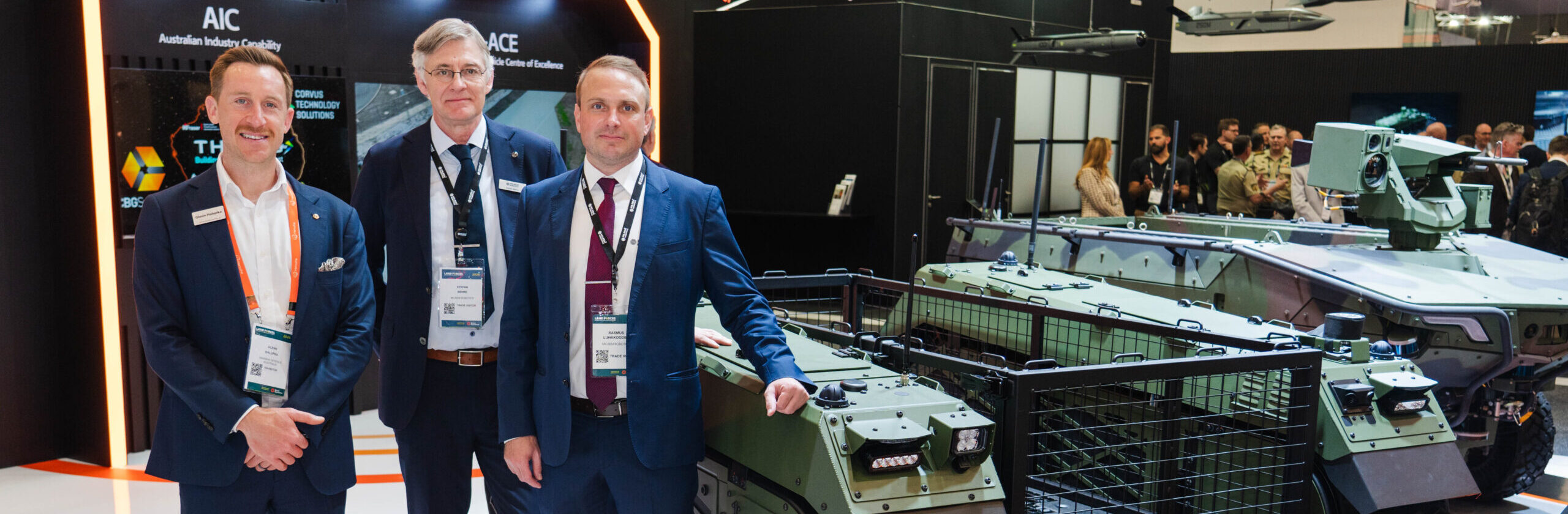
Milrem´s THeMIS, an unmanned ground vehicle (UGV), is part of robotic programmes and is in service across 19 countries. Photo: Konsberg
What are the current export markets and their growth potential? There are obviously also geopolitical constraints on exports of defence products, which may change as the situation evolves. How are these taken into account?
Export of the Estonian defence industry comprised 70% of the sector’s total turnover, and it has significant growth potential. The main export markets are, naturally, allied countries and, in a changing environment, are increasingly European customers, as Europe’s independent defence capabilities are built.
An important part of Europe’s independent defence capability is, of course, the contribution to the defence capability of Ukraine; today, more than ten Estonian companies have products in daily use in Ukraine.
Estonian defence industry companies have worked internationally since their inception due to the limitations of the domestic market, so it is not difficult for our companies to operate flexibly and be where their customer needs them to be. However, our aim is to keep them at least headquartered in Estonia. Strengthening the EU Single Market for defence is essential for this, as is establishing clear legal regulation (or simplifying rules) to allow a defence industry company operating in one member state to access another state’s defence procurements without restrictions.
The European defence industry’s base should be treated EU-wide as part of Europe’s joint defence capability, not on a member-state basis. This approach is fundamental to accelerating the adoption of new, effective defence industry products to quickly increase the force multiplier of European armed forces while reducing the cost of the kill chain and enhancing our rapid European deterrence capability.
A European common market for defence products and goods enables the emergence of a capital market in the EU for the defence industry, comparable to that of the US. Given the current market fragmentation, it is difficult for European defence industry companies to demonstrate growth.
How does Estonia define its competitive advantage in this area, both in terms of sales and foreign investment?
Our competitive advantage rests on four pillars. Firstly, understanding the needs of the end customer – a capability, not a product-based value proposition. What is the job that needs to get done? What goals need to be achieved with this technology?
Secondly, the rapid ability to test products with Estonian customers and integrate the Ukrainian battlefield experience into our own value propositions.
“The real moment of truth for any defence product comes on the battlefield.”
Taavi Veskimägi, chairma of the Council of the Estonian Defence and Aerospace Association
Thirdly, our digital DNA – Estonia is known for its e-solutions, which have been successfully applied in the defence industry. As a member of NATO and the EU, our products comply with international standards, which builds trust among our customers.
Fourthly, our innovative spirit and quick adaptability – we are small and flexible, able to respond quickly to changing needs. As Tormis Saar, Go Craft’s CEO has aptly pointed out: “Speed of adaptation is our advantage”.
Ultimately, our competitive advantage lies in the shift from standard weaponry to smart defence – we are changing the battlefield not with more weapons, but with smarter systems that enable better decisions, faster reactions, and more effective action. We are making combat more effective and achieving more with the same capabilities.

Kusti Salm from Frankenburg Technologies and Taavi Veskimägi at the gathering of Estonian defence industry companies in Tallinn. Foto: Andras Kralla, Äripäev/Scanpix Baltics
How do foreign investors see Estonia in this sector? What is the overall share of foreign investors in the defence industry? How are they affected by the war in Ukraine and what arguments do you use to convince them to invest here?
The attitude of foreign investors towards the Estonian defence industry has changed significantly in recent years. Estonia is a country in Europe that offers good conditions for the defence industry. We offer a strong ecosystem where R&D, production, testing, and export are coordinated. The successful launch of the planned defence industrial park is critical, especially for the scaling-up of ammunition, explosives, and weapon systems production.
Thousands of people with defence technology skills in Estonia will ensure successful implementation of the investments. Our experience in Ukraine allows products to be tested in real conditions and be developed rapidly, accelerating the return on investment.
Ukraine – are we givers or takers? Many Estonian manufacturers are conducting “battlefield trials” in Ukraine. How does this affect their products, processes, and sales?
In the defence of Ukraine, we are, on the one hand, certainly the givers, but on the other hand, we are also the recipients of very important experience and knowledge. More than a dozen Estonian companies are currently working in Ukraine, providing solutions ranging from sensors and surveillance equipment to unmanned platforms, anti-drone systems, field hospitals, and training. We support Ukraine in their fight for freedom.
However, the defence of Ukraine certainly offers invaluable experience for our companies. The battlefield in Ukraine will be a test case to see which technologies really work – the real moment of truth for any defence product comes on the battlefield.
Technological development in Ukraine is very fast – what would take 10 years in peacetime is done much faster. Impractical solutions are immediately discarded, and what remains is what gets the job done.
Ukraine’s experience has spurred the emergence of new companies – Asax Innovation, for example, was set up in response to a Ukrainian partner unit’s need for a different way of evacuating wounded combatants.
In the international market there are now two key questions: is your own defence force using the product, and has it been used in Ukraine? This experience will give our companies a strong competitive advantage for the next 3 to 5 years.
The impact has been noticeable on several levels. Products have become more functional, more reliable, and more user-friendly. For example, the design of Semetron’s field hospitals has been radically changed thanks to the Ukrainian experience, with better materials and more ergonomic solutions.
Processes have sped up, and production has become more flexible. For example, in the use of drones, we have learned that the whole process has to fit into 12 minutes (4 minutes to set up, 4 minutes to launch, and 4 minutes to assemble) to avoid countermeasures.
We have proposed the creation of a public financing envelope (for example, €25 million), which would allow us to send Estonian industry products to Ukraine with our own money. In this way, we would help Ukraine, and at the same time, we would strengthen our own defence capabilities through the development of our defence industry.

Threod Systems drone launch system CATA. Photo: Threod Systems
Estonia’s defence companies aim for €1 billion turnover – in what timeframe? What is the benchmark of success in the next 5 years?
The EDIA has set a target to reach a total turnover of €2 billion in the defence sector by 2030, of which €1.4 billion would come from exports and the scaling up of companies from startups to global players. It is important that more companies with a turnover above 50 to 100 million euros emerge from Estonia.
With a turnover of around €500 million in 2024, this means a fourfold increase over the next 7 years. In the rapidly changing environment of the last few months, this is perhaps not ambitious enough. A strong defence industry is not only vital for national security but also drives economic growth by creating high-value jobs. Countries facing similar geopolitical realities, such as South Korea and Israel, have demonstrated this successfully. However, achieving this requires a comprehensive ecosystem promoted by the government.
“The EDIA has set a target to reach a total turnover of €2 billion in the defence sector by 2030, of which €1.4 billion would come from exports and the scaling up of companies from startups to global players.”
Taavi Veskimägi, chairma of the Council of the Estonian Defence and Aerospace Association
You have said that your focus is on the defence industry and the clean economy. How do they fit together?
There are many technologies and products with a low environmental footprint that meet the capability needs of the Estonian Defence Forces, giving these products a natural competitive advantage to do the same job better and more efficiently. These include, for example, hydrogen, water treatment and battery technologies, energy efficiency solutions, and smart microgrids.
We need to focus on those areas in which low environmental footprint technologies have a natural competitive advantage. In particular, I have tried to invest in companies that cross clean economy and defence, such as PowerUP Fuel Cells, Spacedrip, GaltTec, GScan amongst others.
I believe that cleantech is essential to strengthen Europe’s strategic autonomy to provide more efficient energy solutions based on local primary fuels and to make better use of sustainable materials and material recovery. I therefore see the need to integrate a resilience requirement into the EU ESG taxonomy as part of the social criteria that companies set to ensure their ability to cope with civilian and military crises. I believe ESG social criteria should demand the demonstration of resilience capacity in economic activities of companies and financial institutions.
This content is funded by the European Union – NextGenerationEU.
Are you interested in trading with Estonia? Enterprise Estonia is providing sourcing services for foreign enterprises. Contact Estonian export advisors or use our free e-consulting service to start trade with Estonia.