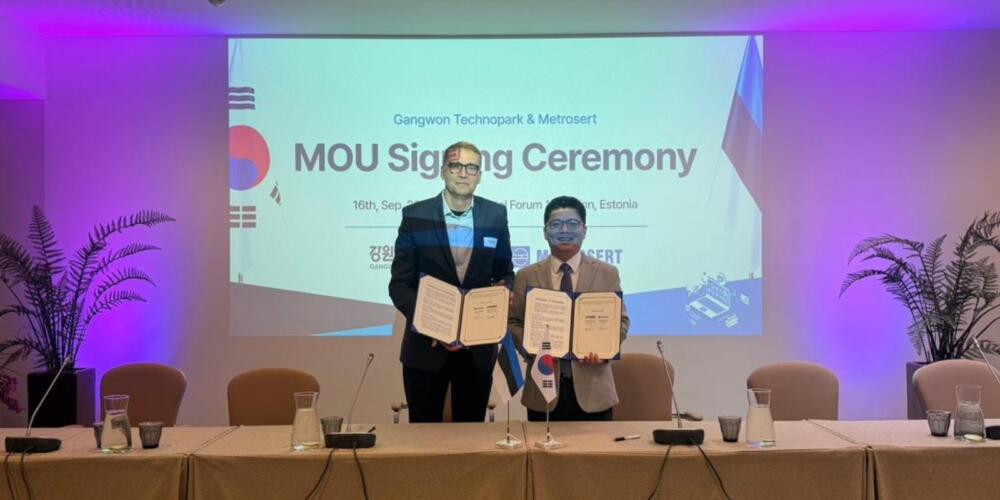
Gangwon Technopark signed an agreement with Estonia’s Metrosert on 16 September to validate South Korean digital health products on Estonian health data, giving Gangwon companies a route into the European market.
The MoU was signed at the Korea–Estonia digital health seminar in Tallinn, organised by Enterprise Estonia with Gangwon Technopark. Metrosert chief executive Madis Raukas and Gangwon Technopark chief executive Heo Jang-hyun signed the three-year agreement. It names AI healthcare, bio, hydrogen energy, future mobility and ICT as its areas of cooperation, and covers market-entry support, joint research, testbed validation and academic and hospital exchanges.
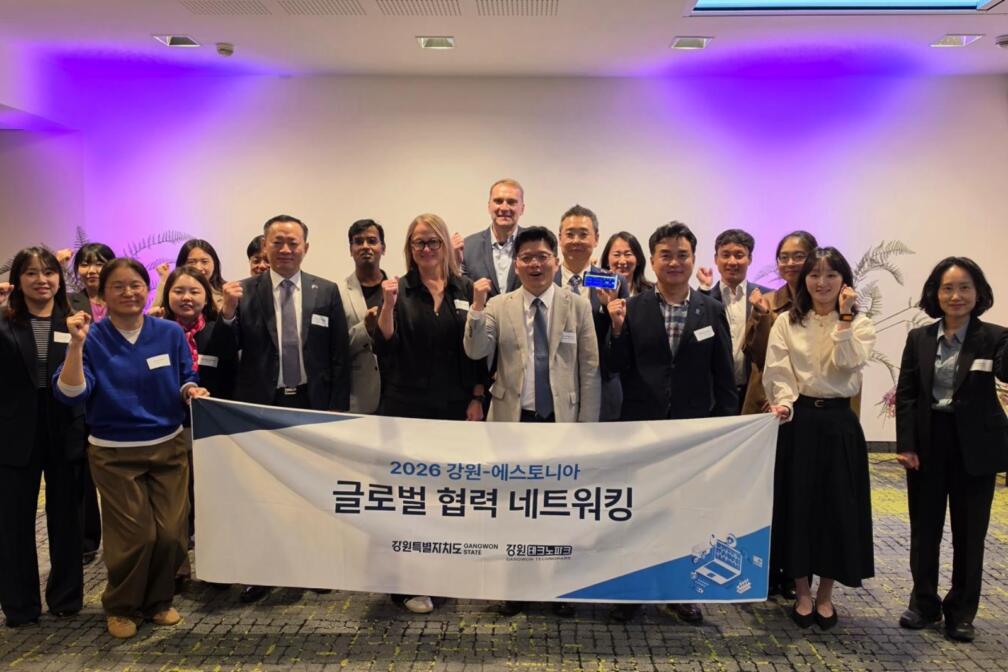
Gangwon is South Korea’s largest province by area, with about 1.5 million residents. Gangwon Technopark runs its AI Healthcare Global Innovation Special Zone, designated by Korea’s Ministry of SMEs and Startups in May 2024 so that health companies can develop products free of regulatory constraints and prepare for certification in overseas markets. A Gangwon State delegation visited Tallinn and Tartu from 15 to 18 September and met Estonia’s health data centre TEHIK, the regulatory sandbox Accelerate Estonia and Tartu Science Park.
Enterprise Estonia invited Estonian healthcare, digital health and biopharma companies to meet Korean partners and explore the Korean market.
Gangwon Technopark’s testing ground in Estonia
Metrosert, a state-owned research organisation with around 140 specialists, validates health technologies against Estonian health records through its Health Data Unit, a draw of Estonia’s HealthTech sector for companies preparing to enter Europe. “We help design studies and data flows, assess data quality and the performance of AI models, and ensure secure data processing,” said Kaupo Reede of Metrosert’s management board.
The partners have already started their first project: the first South Korean health-tech pilot to be validated on Estonian data, a four-week field study of Roopin, an AI running companion built by the Korean company MENINBLOX, with 50 recreational runners in Estonia. Funded by the Gangwon AI Healthcare Global Innovation Zone 2026 programme, it measures whether runners follow the app’s advice and how its recommendations compare with independent sports medicine assessments.
Raukas said Estonia’s size makes it a useful testing ground. “Estonia is a small country, and that is where it may be very useful for you. We can test various healthcare solutions on the entire population,” he said. Estonian companies also presented products in clinical use, among them Better Medicine, whose lineup includes AI for kidney cancer, tested at Tartu University Hospital.
One data model, two health systems
Estonia is moving its national health datasets to the OMOP common data model, which enables different types of health data to be analysed together. “We don’t have to pull data together separately. We don’t have to clean it again,” said Riina Raudne, chief executive of the Centre for Personalised Medicine at the University of Tartu. The national health record, claims and prescription data should run on the model by Christmas, renewed nightly, she said, and Korea’s claims data is already in that format. The agreement makes data standardisation, connectivity and service design built on Estonia’s e-Health system a priority, alongside expert consultation and talent exchange.
The next validation hubs are in the Baltics
The delegation worked to extend its network beyond Estonia, sharing Tartu University Hospital results with Lithuania’s Vasaros Hospital and discussing new validation hubs in the Baltics. “This visit to Estonia will be an important turning point,” Yoon Wan-tae, head of the Future Business Division at Gangwon Technopark, said in the technopark’s press release. “We will work to build a global network so that Gangwon’s AI healthcare solutions can establish clear competitiveness on the European stage.”
Estonia’s goods exports to Korea reached €66.1M in 2025 against €141M of imports, according to Statistics Estonia, and grew by nearly 50% in two years, the foreign ministry said at its Korea Market Day in Tallinn last year. Estonia opened an embassy in Seoul in 2020 and a business centre there in 2023, and Korean defence company Hanwha Aerospace has cooperation agreements with Milrem, Nortal and SensusQ.
Korea’s ambassador to Estonia, Ileung Kim, said ageing populations make artificial intelligence a necessity, not an option. Ege Devon, who heads Enterprise Estonia’s foreign consultants division, said the cooperation runs in both directions. “For Estonian companies, cooperation with Gangwon can open doors in Korea. For Korean companies, partnerships in Estonia can support their development in Europe,” she said.
Are you interested in trading with Estonia? Enterprise Estonia is providing sourcing services for foreign enterprises. Contact Estonian export advisors or use our free e-consulting service to start trade with Estonia.