No driver required: German startup Bliq just became the first company to run fully driverless cars on EU public roads, with Tallinn as the testing ground.
Estonia doesn’t have a reputation as a startup test bed for nothing, and it once again proves it when it comes to driverless tech. It already officially allows Tesla’s Full Self-Driving (FSD) Supervised system on public roads and paves the way for European innovations.
This May, Berlin-based Bliq.ai received approval to operate its vehicles on Estonian public roads without a driver behind the wheel. It is the first time an EU member state has granted this kind of authorisation, allowing Bliq to operate cars under remote supervision rather than with a safety driver on board. According to the new report by Electiala, the cars are already roaming the streets of the capital.
The company already has a dozen vehicles operating in Tallinn, with further expansion underway. Bliq describes this as the largest fully driverless fleet in Europe. The approval followed test-track sessions and real-world trials in Tallinn traffic, conducted first with a safety driver before authorities signed off on driver-free operation.
Julian Glaab, Bliq’s CEO and co-founder, framed the approval as a turning point for the industry: “Europe has now crossed a major threshold for driverless mobility.” He added: “This approval shows that fully driverless vehicles can be developed, validated, and deployed in Europe today. Our goal is to bring this technology to consumers and businesses across the continent as quickly and safely as possible.”
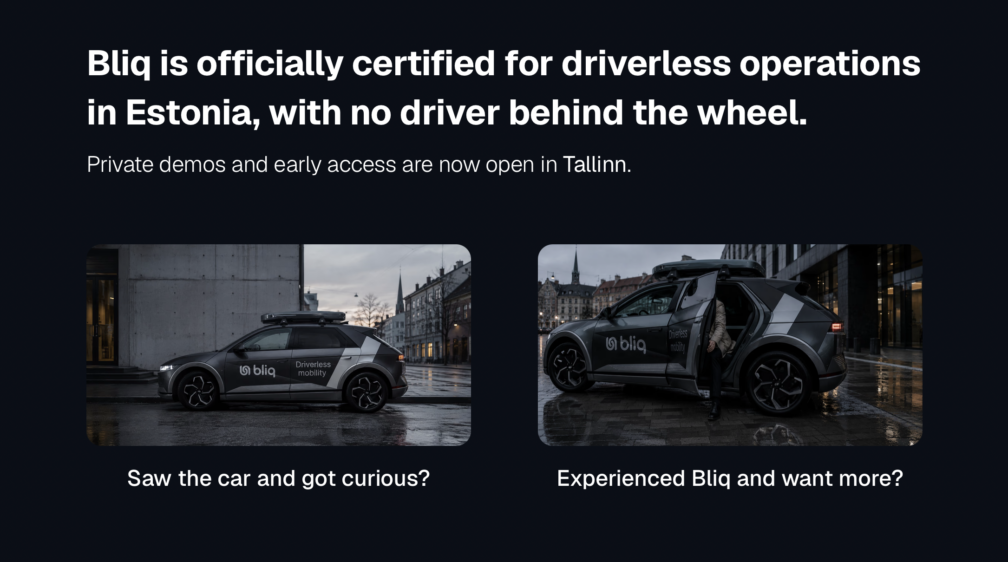
This spring, Berlin-based Bliq.ai received approval to operate its vehicles on Estonian public roads without a driver behind the wheel and is advertising this on its website.
How Bliq approaches driverless tech
Bliq does not build its own cars. Instead, it retrofits existing software-defined vehicles, in this case a Hyundai IONIQ 5, with a sensor and compute package that converts them into driverless cars. The current setup combines an AI-based Level 2 driving system with a remote human supervisor able to step in if required. That is a faster path to market than designing a purpose-built robotaxi, and it is central to how Bliq positions itself against competitors.
“Driverless cars should not be limited to robotaxi fleets,” said Torgen Hauschild, the company’s CTO and co-founder. “We believe the biggest opportunity is making autonomous mobility available in the vehicles people and businesses use every day. Our retrofit model, remote-supervised architecture, and shipping-focused engineering approach are designed to make that possible.”
Tallinn’s transport authority is one of the few in Europe willing to let companies test autonomous driving in live traffic, and Bliq has made use of that latitude.
In a test ride reported by Estonian outlet Elektriala, a Bliq IONIQ 5 manoeuvred itself out of a petrol station near Tallinn’s Linnahall with the driver’s seat empty. The only outward sign of the car’s hardware is a streamlined module on the roof that houses the sensors and onboard AI, which the outlet likened to a digital periscope.
The Estonian approval is one part of a broader European push. Bliq says it is working through regulatory processes in several other countries, with Germany next in line. The company is backed by NEA and Atlantic and operates out of Berlin and Tallinn, with a team drawn from autonomous driving, automotive engineering, regulation, and functional safety.
Are you interested in trading with Estonia? Enterprise Estonia is providing sourcing services for foreign enterprises. Contact Estonian export advisors or use our free e-consulting service to start trade with Estonia.