German industry’s verdict: Europe’s next tech bottleneck isn’t the chip, it’s the circuit board, and Estonian PCB makers are already positioning for it ahead of Electronica 2026.
Chips have dominated Europe’s tech policy conversations for years, and has seen new rise in prominence over the last few years of AI boom. But at a conference in Nuremberg in June, German industry leaders pointed to a different weak spot: printed circuit boards (PCBs), the boards that hold and connect a device’s components. Estonia is ready to step in, already attracting major investments in the sector.
Tiina Kivikas, Enterprise Estonia’s export adviser for Germany, attended the event, titled “HDI PCBs | Enabler for Chip Packaging, Mobility and Defense”. Her takeaway: Europe’s strategic question is no longer just about who makes chips, but whether the continent can produce the PCBs, substrates and materials that the next generation of electronics will run on.
That matters for Estonia too. Ahead of Electronica, the world’s largest electronics trade fair, in November, Enterprise Estonia is arranging meetings between European firms and a group of Estonian companies, including Artec Design, Aurightec Estonia, Incap Electronics, Note Pärnu, Rantelon, Brandner Electronics, Audes LCC and the Estonian Electronics Industry Association.

Discussing circuit bottlenecks at HDI PCBs | Enabler for Chip Packaging, Mobility and Defense”. Photo by Bayern Innovativ
Circuit caution is creeping in, with AI is straining more than the chip
Speakers from Infineon, Schaeffler, Schweizer Electronic, Würth Elektronik, AT&S and Fraunhofer described an industry advancing on several fronts at once while facing sharper weak points. A Fraunhofer representative noted that German firms have grown warier about investing in innovation and prototypes, a shift for a sector once known for testing ideas quickly. The technical focus has moved on too: from shrinking chips to packaging, connecting, cooling and testing them.
Andreas Ostmann of Fraunhofer IZM explained how AI infrastructure is reshaping the wider electronics supply chain. Today’s leading modules measure around 80 by 80 millimetres; future AI modules could grow to 200 by 200 millimetres, with packaging scales shrinking below five micrometres. Nvidia’s new Vera Rubin AI platform illustrates the shift, placing new demands on chips, packaging and circuit boards alike.
Axel Hahn of Infineon added that AI, high-performance computing and data centres are driving growth, even as products grow more complex and development cycles shrink. That’s pushing the industry towards fan-out packaging and 2.5D architectures (methods of stacking and connecting chips more densely), which improve performance but complicate supply chains.
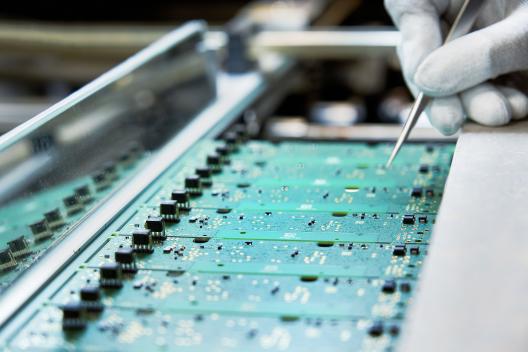
Incap, Estonia-based precise electronics and PCB producer
This is where Europe’s exposure shows. Both the US and EU want stronger domestic chip manufacturing, but the global industry still leans heavily on Taiwan and China, a dependence that extends well beyond chips to substrates, materials and PCBs.
Tarja Rapala-Virtanen, board member of the Estonian PCB manufacturer Brandner Electronics, said the industry sees opportunity in the challenge. “Europe’s strength lies in world-class expertise across the entire PCB ecosystem,” she said, “but holding that position requires stronger pan-European investment in research and development, pilot production, manufacturing capacity, and sustainable access to critical materials.” She added that speeding up innovation depends on close cooperation between industry, research institutions and technology organisations, and on involving the whole supply chain, from material suppliers to end producers, to qualify new technologies quickly.
Glass, testing and “green gold”
AT&S sees glass substrates as the likely next step beyond today’s organic and silicon-based materials, offering better dimensional stability and electrical performance, though at a steep development cost.
Andreas Schulze of Schaeffler flagged a less-discussed issue: testing and qualification. Longer-lived, more complex electronic systems need better ageing models and a more unified European testing framework, something even a company Schaeffler’s size struggles to organise.
“PCB is the new green gold,” said Daniel Klein of Würth Elektronik. His point was that Europe won’t win on price, but it can win on quality, reliability and dependable supply chains.
Arno Kolk, managing director of the Estonian Electronics Industry Association, said the shifts under way create new openings for Estonian firms, and invited visitors to Estonia’s stand at Electronica 2026 and the “EMS & Beyond” seminar.
whAre you interested in trading with Estonia? Enterprise Estonia is providing sourcing services for foreign enterprises. Contact Estonian export advisors or use our free e-consulting service to start trade with Estonia.