From second-hand fashion to regenerative farming, a small group of Estonian startups is discovering that Africa’s fast-growing markets reward those willing to adapt.
Estonia has built its reputation on digital infrastructure, e-governance and a startup culture. But as European markets mature and competition intensifies, a growing number of Estonian companies are looking further afield — and Africa is increasingly on the map.
With a combined population of over 1.4 billion, rapid smartphone adoption and a middle class expanding faster than almost anywhere else in the world, the continent offers something that saturated Western markets rarely do: room to grow. The Africa Business Forum, taking place in Tallinn on 26 May, is one sign that this interest is becoming stronger. And the success stories are already proving the potential.
Startups on the rise
Aune Aunapuu has a straightforward explanation for why South Africa is now Yaga’s largest market: the infrastructure for peer-to-peer trade is already there – it just isn’t safe or organised. “South Africa is currently Yaga’s largest and fastest-growing market,” she says. Her platform, which enables the buying and selling of second-hand fashion and launched in South Africa in 2020, now has more than one million users in the country.
Nearly €60M worth of goods changes hands through it annually, and the company is growing at 70% per year. Globally, more than eight million second-hand items have been sold through Yaga, roughly half of them in South Africa. The company recently raised €4.2M to press ahead with plans to become the leading resale platform across Africa and the Middle East.

Team of Yaga, Estonian-built second hand marketplace, which is rapidly expanding in Africa. Photo by Yaga
eAgronom, an Estonian AgriTech company, is pursuing a different opportunity. Working primarily in Rwanda, Kenya and Tanzania, it is helping smallholder farmers transition to regenerative agricultural practices – and, in doing so, generating carbon credits.
Efrain Pompa, the company’s Head of Western Europe and Africa Partnerships, describes the model: “We train farmers in regenerative agriculture practices, and they use eAgronom’s CRM platform, where historical and current data on farming practices is collected.” That data is verified by satellite and validated by an independent certifier for carbon credit issuance.
Rwanda has proved the most advanced market. Pompa attributes this to low corruption levels, a government that actively supports regenerative farming, and a well-developed network of agricultural cooperatives. eAgronom is now preparing for a growth phase there, while Kenya and Tanzania remain in the pilot stage, with wider expansion planned for next year.
Lessons that travel across sectors
Despite operating in entirely different industries, Yaga and eAgronom have arrived at remarkably similar conclusions about doing business in Africa. Both companies stress that European solutions cannot simply be transplanted. For Yaga, adaptation means localised payment options, logistics and languages, as well as building consumer trust in a category – digital second-hand fashion – that is still relatively new to the region. For eAgronom, it means translating its data collection platform into local languages and structuring workflows so that the data farmers submit can withstand scrutiny from external certifiers.
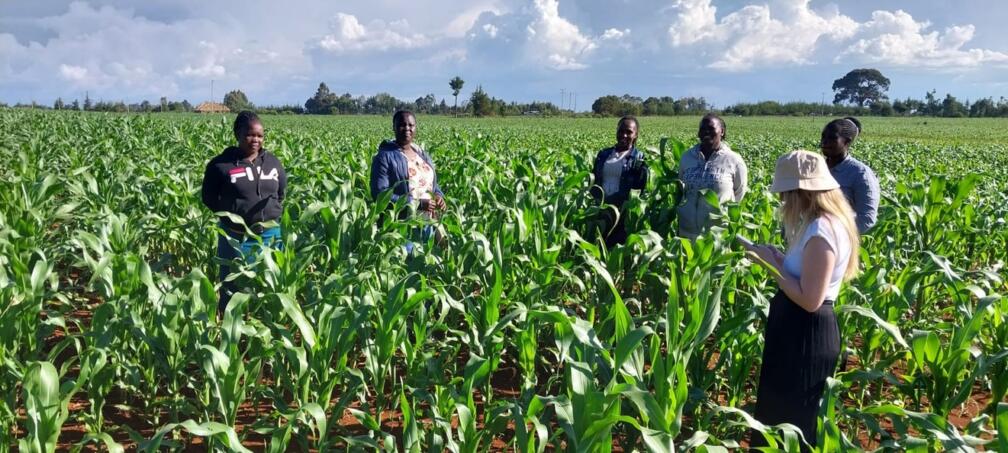
eAgronom, which is present in Rwanda, Kenya and Tanzania, helps local farmers align with global carbon market and increase efficiency. Photo by eAgronom
Local partnerships are also non-negotiable. “Long-term climate and agricultural projects, lasting up to 20 years, cannot be managed remotely,” Pompa said. “You need partners who understand local communities, languages and ways of working.”
Aunapuu had her own version of the same lesson. One of her biggest surprises was the central role WhatsApp plays in South African business. “Logistics partners and even banks communicate via WhatsApp, and it is often the main channel for business communication,” she said. Building relationships before pushing towards transactions is equally important – South African business culture places greater weight on personal rapport than Estonians are typically used to. “It is not better or worse, just different,” Aunapuu noted.
A continent that moves fast
Yaga and eAgronom are not alone. Bolt, Cybernetica, Digital Nation, Pipedrive and Wise are among the other Estonian companies with a presence across the continent.
Daniel Schaer, Estonia’s Ambassador to Kenya and South Africa, sees a broader pattern. “Our strengths – technological thinking, data-driven approaches and the ability to build scalable solutions – work well in African markets, but they must go hand in hand with understanding local conditions, taking a long-term view and being prepared to adapt solutions,” he said.
Schaer describes Africa as the world’s fastest-developing continent and argues that Estonian companies should be part of that growth. Estonia is also opening a new embassy in Kenya this year, partly to support the development of economic relations.
The Africa Business Forum, taking place in Tallinn on 26 May, will bring together business leaders and government representatives from Estonia and African countries.
Are you interested in trading with Estonia? Enterprise Estonia is providing sourcing services for foreign enterprises. Contact Estonian export advisors or use our free e-consulting service to start trade with Estonia.